The FY2026 Performance Appraisal Plan. POPA’s dismantling. The “settled expectations” memo. Not independent policy decisions. They are a single architecture. And not built in your favor.
Google LLC, Samsung Electronics Co., and Western Digital Technologies Inc. have each filed constitutional challenges at the US Court of Appeals for the Federal Circuit against the USPTO’s restructuring of inter partes review (IPR) proceedings. These are not companies that file suit lightly. The fact that three of the most sophisticated IP portfolios in the world have simultaneously concluded that the administrative tribunal designed to kill bad patents is now structurally compromised tells you more about the current prosecution environment than any official agency communication will.
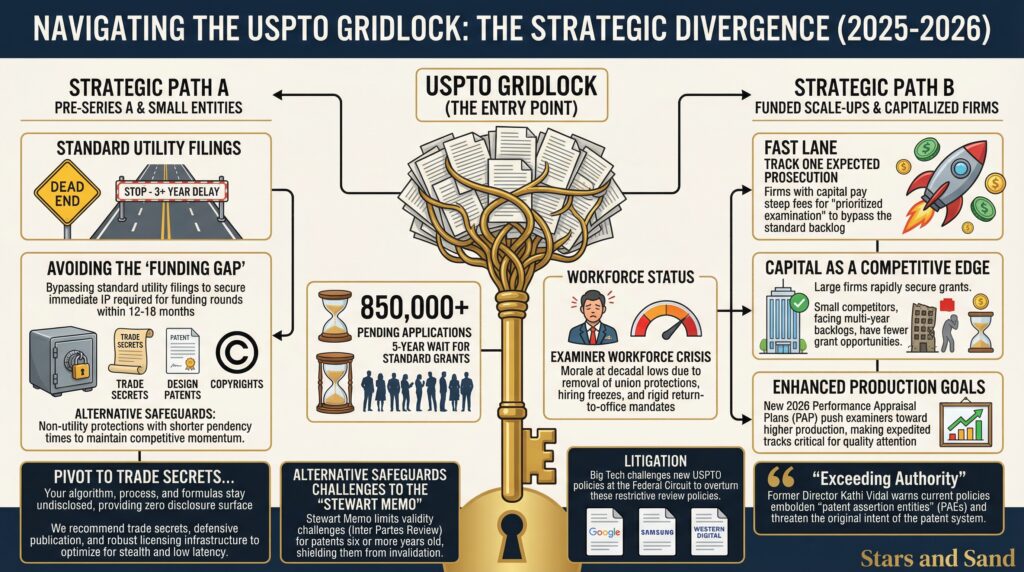
The precise target of those challenges is a memo issued by Deputy Director Coke Morgan Stewart establishing a new discretionary denial factor: patents six years or older now carry “settled expectations” — meaning the PTAB director holds authority to simply refuse an IPR petition challenging them. That single policy shift has materially altered the risk calculus for every patent assertion entity operating in the United States. Former USPTO Director Kathi Vidal, who led the agency from 2022 to 2024, stated publicly that the policy is “completely exceeding its authority” and has emboldened PAEs “to an extreme.” The word “extreme” is doing serious load-bearing work in that sentence.
Understanding why this matters to a technical founder entering the US patent system requires understanding what the PTAB was originally designed to do, and what it now structurally cannot.
What the PTAB Actually Was
The Patent Trial and Appeal Board was established under the America Invents Act (AIA) of 2011 as an administrative tribunal specifically designed to provide a faster, cheaper alternative to federal district court litigation for challenging patent validity. An IPR at the PTAB runs approximately $400,000 per side — a significant sum, but tractable for a funded company facing an extortion-level licensing demand. The alternative — federal district court litigation — starts at $3 million and scales from there.
For operating tech companies, the PTAB functioned as a pressure-release valve. When a patent assertion entity (PAE) — a non-practicing entity whose sole business model is licensing fees extracted through infringement threats — approached with a weak but old patent, the PTAB was the efficient, evidence-based route to kill it. The PAE business model specifically relies on litigation cost asymmetry: it costs them far less to sue than it costs you to defend, so even a meritless claim generates settlement economics in their favor. The PTAB closed that gap. Deputy Director Stewart’s memo re-opens it.
Garbage Collector or Just Aggressive?
Think of the PTAB as your system’s garbage collector — a background process that continuously identified and removed dangerously low-quality allocations from the codebase. The “settled expectations” memo has now told that garbage collector to ignore any object older than six years. That is not a minor configuration change. That is a decision to let memory rot accumulate indefinitely, and to force every application that encounters it to handle the exception in real time, at full cost, in district court.
Vidal confirmed the consequence directly: PAEs are now launching aggressive infringement campaigns against operating tech companies. She cited pharmaceutical companies being sued for using basic WiFi functionality as a specific instance. When a pharmaceutical company gets sued for WiFi, the targeting logic has fully decoupled from technical merit. That is what happens when the garbage collector goes offline.
The Prosecution Trap: How the Examiner Corps Is Collapsing
The PTAB restriction is one jaw of the trap. The other jaw is inside the examination pipeline itself.
The USPTO entered FY2026 carrying a backlog of over 820,000 unexamined patent applications — a decade-high figure. On October 1, 2025, the agency deployed the FY2026 Performance Appraisal Plan (PAP), which raised production quotas for individual examiners and added new supervisory task loads. In parallel, the administration invoked a presidentially declared national security designation to strip collective bargaining rights from the Patent Office Professional Association (POPA), which represents more than 9,000 examiners — over half of the USPTO’s approximately 15,000-person workforce.
POPA had secured a collective bargaining agreement in December 2024 explicitly protecting remote work arrangements through June 2029. A joint OMB/OPM memorandum issued in January 2025 immediately overrode that architecture, requiring agencies to submit return-to-office implementation plans by February 7, 2025. This matters at the scale it does because over 80 to 85 percent of USPTO staff — by some internal metrics, up to 95 percent — works remotely. USPTO built the agency’s entire operational topology on distributed work. Collapsing it on a sub-45-day notice window is not a policy transition; it is a forced reboot with no rollback plan.
Environmental Factors
The geographic consolidation extends to physical infrastructure. The AIA of 2011 explicitly required the USPTO to establish and maintain at least three regional offices. The Trump administration closed the Rocky Mountain Regional Office in Denver, citing $1 million in cost savings and noting a physical headcount of ten employees. Former Deputy Director and Rocky Mountain Regional Director Russell Slifer immediately corrected the record: Denver served as the official duty station for hundreds of remote examiners and PTAB judges. Management has now left those employees administratively unmoored. The remaining regional offices in Detroit, Dallas, and San Jose now carry the signal of an existential threat rather than institutional permanence. The planned Southeast Regional Outreach Office in Atlanta was cancelled outright and folded into Alexandria headquarters.
The internal environment is operating under conditions that produce attrition, not productivity. Two-thirds of the USPTO executive board was replaced. Director nominee John Squires was awaiting Senate confirmation. The agency implemented a hiring freeze. It reduced travel expenditures by 86 percent. In March 2025 it informed a self-funded, revenue-positive agency’s workforce that layoffs were possible. An April 2025 initiative attempted to shift the workforce to a continuous evaluation background check protocol. A May 2025 IT policy cut off access to personal email accounts on work devices. Employee morale is, by direct internal account, “in the toilet” — with a workforce described as operating in a culture of active paranoia.
Consequences
The attrition numbers are structural. The agency is currently operating with at least 1,600 fewer examiners than required. The PTAB has lost approximately 30 administrative judges — 13 percent of the entire tribunal — since January 2025. Senior examiners are retiring early or resigning. Junior examiners lack the mentorship pipeline required for consistent prior art analysis. The Government Accountability Office has explicitly warned that the agency’s focus on clearing the backlog is coming at the direct expense of examination quality.
The output of this environment is predictable: average pendency, which had previously been driven below 2.5 years, is now moving back toward three years. For a technical founder from Lagos or São Paulo who is filing a US utility patent as a core asset in an investor pitch, three years is not a delay — it is a business event.
The Counter-Argument and Why It Fails
The administration’s stated counter-strategy is aggressive: the USPTO obtained an exemption from the federal hiring freeze to recruit new patent examiners specifically for non-union, non-telework-eligible positions at the Alexandria headquarters. To attract electrical engineering examiners, the agency is offering a $10,000 entry bonus and an additional $20,000 bonus for a two-grade promotion achieved within 48 months. For the existing workforce, a March 2025 pilot bonus program allows examiners to earn up to 2.7 percent of their salary per quarter for increased application output.
This is a reasonable argument on paper. Junior engineers, well-compensated, filing in volume at a central facility — it reads like a productivity architecture. The problem is the absence of the variable that makes examination quality non-trivially achievable: mentorship from senior examiners who understand prior art topology across a technical vertical. Those senior examiners are leaving. The new Alexandria hires will process applications against production quotas with inadequate institutional knowledge and no union-negotiated procedural backstop. The result is not faster, better examination. It is faster, worse examination. The GAO has said exactly this.
More critically, the structural outcome of faster, lower-quality examination is not a neutral condition — it is actively hostile when paired with the PTAB restrictions. The pipeline is now configured to issue more patents with weaker claim scope and inconsistent prior art analysis, and then to shield those patents from administrative challenge once they age past six years. That is a precise description of the conditions required to arm a patent assertion entity. A PAE does not need a strong patent. It needs a valid patent — one that will survive a motion to dismiss long enough to generate settlement economics. The USPTO’s current configuration produces those at scale, removes the cheapest mechanism to destroy them, and leaves district court as the only option.
The Bifurcated Strategic Response
The appropriate response to a structurally compromised examination pipeline is not to wait for institutional correction. The correction timeline is undefined. The litigation wave is not.
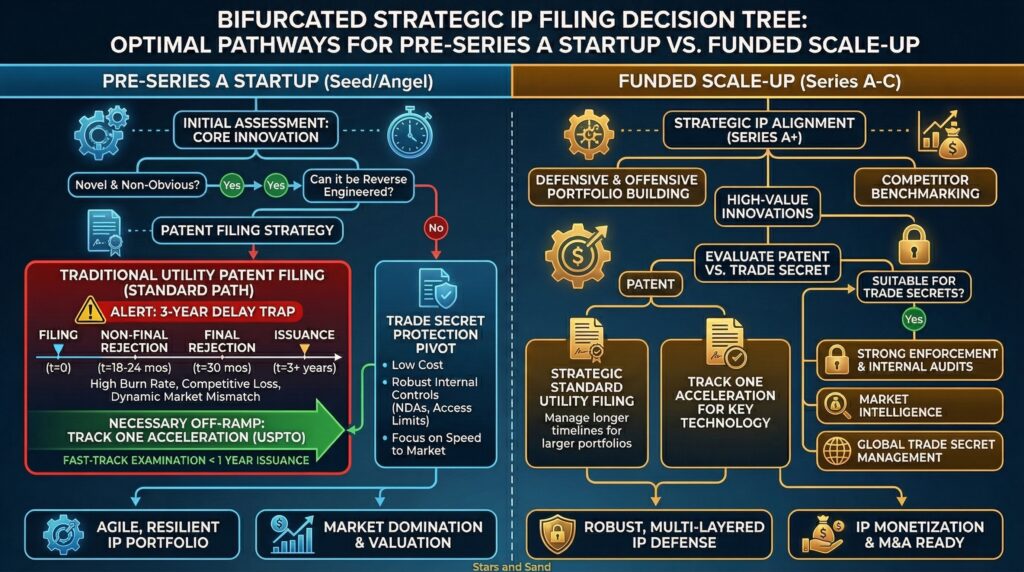
For pre-Series A startups, independent inventors, and small entities
The standard utility patent pipeline is now structurally misaligned with your capitalization window. A three-year pendency means examiners will not review your core IP before your Series A round closes — or fails to close. More importantly, the examination quality at the end of that pipeline is no longer reliable enough to justify the prosecution cost, which runs $15,000 to $30,000 for a well-filed utility application.
The correct architecture is to treat your core algorithms and software as trade secrets — air-gapped systems with no disclosure surface. Document your invention date meticulously, but do not hand it to an understaffed, production-pressured examiner operating without senior mentorship. Layer design patents and copyright registrations over your deployable UI and creative expression where appropriate. These do not require examiner quality to hold — they require your implementation to be distinctive and documented. The prosecution decision tree for a sub-Series A entity right now runs through trade secret architecture first, not the USPTO.
For funded scale-ups, Series B and beyond, and technically capitalized biotech firms
The cost calculus has shifted, but the filing imperative has not. You need issued patents. The difference is that you cannot afford to wait for the standard examination pool. You cannot afford to have mission-critical claims examined by junior staff operating under volume quotas. Track One prioritized examination is no longer an optional premium feature. It is a required infrastructure cost for any asset you consider strategically material. Track One currently costs approximately $4,000 in government fees for large entities ($2,000 for small entities) on top of standard prosecution costs. Against a three-year delay in a deteriorating examination environment, that fee is not overhead — it is a bypass. Use it for every filing that underpins a product line, a licensing narrative, or an investor thesis.
Beyond prosecution posture, funded entities must also explicitly revise their legal budget architecture to account for the post-PTAB defensive environment. The “settled expectations” memo means that PAE attacks on patents older than six years will now land in district court. Not at the PTAB. Model your PAE defense exposure accordingly. Allocate reserves for federal litigation rather than assuming an $400,000 IPR is the ceiling. It is not the ceiling anymore. Google, Samsung, and Western Digital are litigating at the Federal Circuit to get that ceiling back. Until they succeed — and the outcome of those constitutional challenges is not certain. Your defensive budget operates in a district-court-first environment.
The System Architects’ Read
The USPTO’s FY2026 configuration is not a temporary dysfunction. It is the predictable output of three simultaneous policy vectors. Production-quota acceleration, institutional talent destruction, and administrative challenge restriction. Each individually might be survivable but in combination create a structurally hostile environment. For any founder who assumed the patent system would process their application with the institutional rigor it was designed to provide.
Lawmakers did not build the patent system for you. The designers built the patent system for incumbents who can absorb three-year delays and $3 million in district court defense. The architecture you choose in the next 12 months determines whether you operate on your terms or theirs.
— Stars and Sand US Patent Strategies for the World