The Arrhenius Equation Is 140 Years Old. Here Is How One Company Made It Proprietary.
In 1981, the Supreme Court permitted a rubber manufacturer to build patent protection around a mathematical formula that had been freely available to the scientific community since 1884. Diamond v. Diehr, 450 U.S. 175, did not grant them the Arrhenius equation. It did something more operationally significant: it demonstrated, with surgical precision, exactly how the integration of an abstract formula into a physical process produces a protectable asset. Your algorithm is not structurally different. Your chemical process is not legally different. The question the USPTO will ask when it reviews your application is the same question the Court answered in Diehr — and if you have not answered it first, inside the four corners of your claim, you will not like what the examiner sends back.
The Statute Says “Anything.” The Courts Have a Different Definition.
Title 35 U.S.C. § 101 extends patent protection to any new and useful manufacture or composition of matter. When Congress recodified the patent laws in 1952, it deliberately replaced the word “art” with “process.” The legislative intent was explicit: broad coverage. The Committee Reports accompanying the 1952 Act state that patentable subject matter was intended to include “anything under the sun that is made by man.” Technically fluent founders read that sentence and draw the wrong conclusion.
The Supreme Court has carved three categorical exclusions that the “anything under the sun” language does not reach: laws of nature, natural phenomena, and abstract ideas. Einstein’s theory of relativity is not patentable. Newton’s law of gravity is not patentable. A mathematical algorithm without a physical anchor is not patentable. These are the foundational operating parameters of computation and chemistry — they belong to everyone, and therefore to no one. The mistake is treating these exclusions as narrow exceptions. They are the walls of the room in which all patent prosecution takes place.
The Negative Boundary: Two Cases You Cannot Afford to Misread
Think of a patent claim as a fence drawn around a piece of intellectual territory. Draw the fence too wide and it encloses public commons — ground that belongs to the field, not to you. The USPTO will reject it. Federal courts will confirm the rejection. Two Supreme Court decisions establish, with precision, where the fence line becomes illegal.
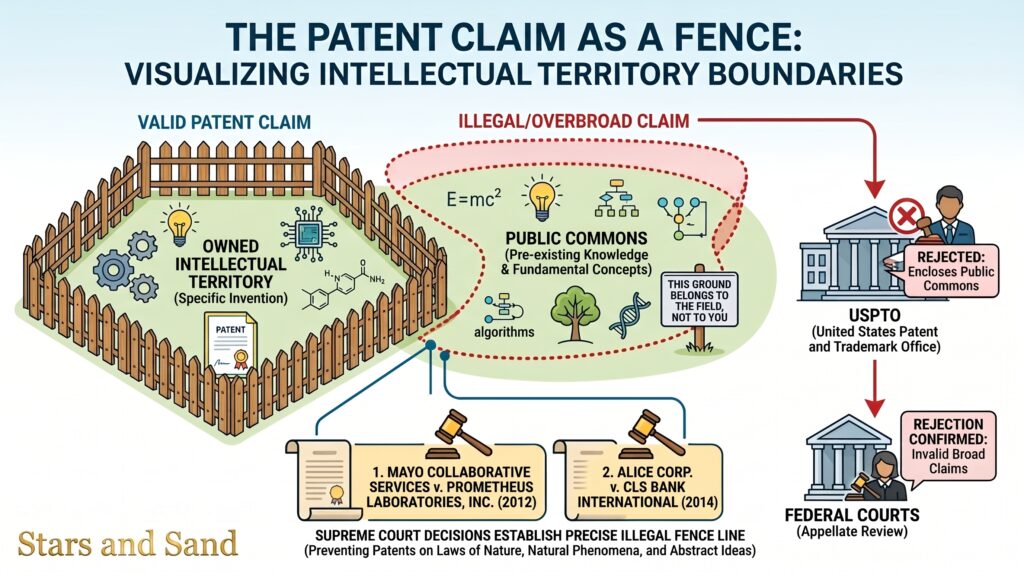
Gottschalk v. Benson, 409 U.S. 63 (1972), applied the doctrine of preemption to software. The applicant sought a patent on a method for converting binary-coded decimal numerals into pure binary form. The process was mathematically valid. It was novel. It required substantial effort to construct. The Supreme Court invalidated the claims entirely. By seeking to patent the algorithm itself — unconnected to any specific machinery or particular application — the applicant was attempting to monopolize the mathematical relationship. Every future use of that conversion method, by any person, for any purpose, would require a license. The Court held that a mathematical algorithm is a fundamental truth of computation, equivalent in legal status to a law of nature, and falls categorically outside 35 U.S.C. § 101.
Benson, the Structural Test
The structural test Benson establishes is this: if the claim were granted, would it prevent anyone from using this mathematical relationship in any context, for any purpose? If yes, the claim fails. The fence has enclosed public commons.
Brenner v. Manson, 383 U.S. 519 (1966), draws the equivalent boundary in chemistry. The applicant had discovered a novel process for synthesizing a known steroid. The process was functional and previously undiscovered. Justice Fortas, writing for the majority, denied the patent on a single ground: the applicant could not show that the steroid served any practical function. The Court established an explicit rule — a chemical process patent creates what it named a “monopoly of knowledge,” and such a monopoly will only be permitted when the applicant demonstrates that a specific benefit exists in currently available form. Speculative utility, downstream promise, or theoretical application is legally insufficient.
The engineering equivalent: you cannot obtain a deed for land you have never built on. Knowing a compound might have therapeutic properties is not specific utility under Brenner. Knowing it inhibits a defined receptor and produces a documented measurable effect is. The difference between those two statements is the difference between a rejection and an allowance.
Benson kills the algorithmic land grab. Brenner kills the chemical placeholder. Both are active law. Both are applied routinely.
The Positive Path: What the Jurisprudence Actually Permits
Diamond v. Chakrabarty, 447 U.S. 303 (1980), and Diamond v. Diehr, 450 U.S. 175 (1981), are decided one year apart. Read as a pair, they are the complete technical blueprint for § 101 eligibility.

In Chakrabarty, microbiologist Ananda Chakrabarty applied for a patent on a genetically engineered Pseudomonas bacterium. The organism was constructed to carry four plasmids — each capable of degrading a different component of crude oil, including camphor and octane. No naturally occurring bacterium possessed this combination of properties. Chief Justice Burger, writing for a five-justice majority, affirmed the patent. The organism was a human-made composition of matter with an immediately specific, physically demonstrable utility: breaking down crude oil. The fact that it was a living organism was, in the Court’s framing, “without legal significance.” What mattered was that it was not found in nature and that it performed a specific, non-natural function tied to a concrete, present-tense result.
The Court drew an explicit contrast with Funk Brothers Seed Co. v. Kalo Inoculant Company (1948), where the applicant had isolated naturally occurring bacteria and combined them without engineering any new capability into the organisms. Funk Brothers failed. Chakrabarty succeeded. The differentiator was not ingenuity in the abstract. It was the production of a new composition of matter with a specific, non-natural function — one with immediate, physical utility that existed in available form on the date of filing.
Diamond v. Diehr Applied to Software
Diamond v. Diehr runs the same logic through software and makes the test explicit. The applicants had developed a process for molding rubber using a computer to monitor mold temperature in real time and calculate, continuously, when to open the press. The calculation used the Arrhenius equation — published by Svante Arrhenius in 1884 and freely available to every chemist and engineer since. The USPTO rejected the claims. The Supreme Court reversed. Justice Rehnquist held that claims must be considered as a whole.
The examiner had dissected the application, isolated the mathematical formula, declared it unpatentable, and invalidated the remaining claims on that basis. Diehr explicitly prohibits this analytical method. A claim that integrates an algorithm into a specific physical process — one that transforms material from one state to another — satisfies 35 U.S.C. § 101 on its face. The Arrhenius equation remained in the public domain after Diehr. The system that used it to produce precisely cured rubber, in a specific physical configuration, producing a specific physical result, was not.
The architecture is clear. The algorithm is not the patent. The algorithm integrated into a physical transformation is.
The Argument a Well-Funded Legal Team Will Make to Maintain Patent Protection, and Why It Fails
A scale-up with significant capital will arrive at this question under board pressure to build a broad intellectual property position. Its general counsel will argue that Chakrabarty’s “anything under the sun that is made by man” standard, read alongside the R&D investment required to build the platform, satisfies § 101 automatically. It will further point to Chakrabarty’s explicit rejection of public policy arguments. When the case was briefed, opponents warned that biological patents could threaten human health, concentrate dangerous capabilities in private hands, and reduce genetic diversity. Chief Justice Burger dismissed these concerns, holding that balancing competing policy values belongs exclusively to the legislature. The scale-up’s counsel will read this as judicial clearance for aggressive, broad claims.
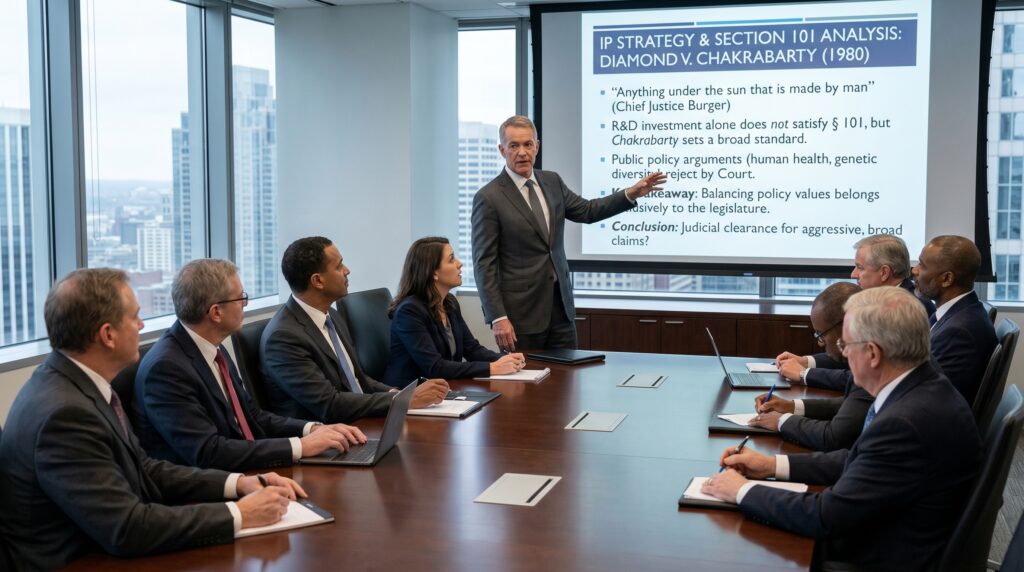
It does not provide that clearance.
Is Patent Protection Really Anything Under the Sun?
Chakrabarty did not suspend Benson or Brenner. The “made by man” standard operates within the judicial prohibition on patenting abstract ideas and fundamental laws of nature — it does not supersede it. The majority in Chakrabarty permitted the patent because Chakrabarty had engineered a new composition of matter with specific, immediate, physical utility. The moment a scale-up’s claims migrate toward the raw algorithm — toward the mathematical relationship the platform applies, or the chemical process that underpins its output in isolation — Benson and Brenner engage regardless of the filing budget.
Justice Brennan’s dissent in Chakrabarty, joined by three justices, made the statutory architecture explicit: Congress has historically treated only specific subsets of human-made inventions as patentable, as demonstrated by the deliberate exclusion of bacteria from both the 1930 Plant Patent Act and the 1970 Plant Variety Protection Act. The majority allowed Chakrabarty’s patent on the specific facts before it. It did not open the claims category to everything a funded team could draft.
Scale does not cure a § 101 defect. The examiner’s abstract idea analysis does not adjust to accommodate the size of the retainer.
The Strategic Implication
Every claim in a software or biotech application must answer one question before it reaches the examiner: what physical state does this claim transform, and what specific benefit is available from that transformation, in the present tense, on the filing date?
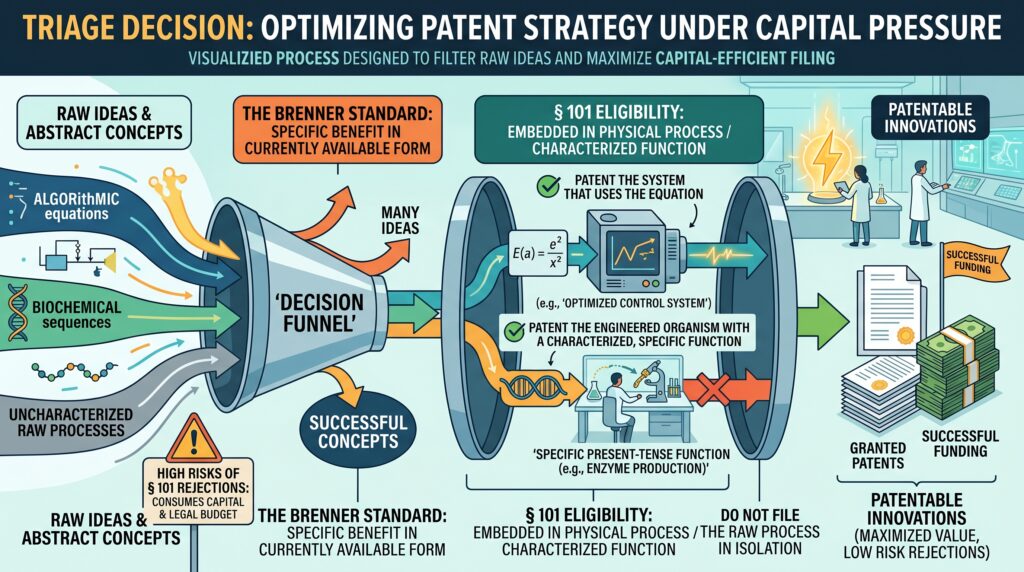
For the early-stage operation under capital pressure, this is not a theoretical inquiry. It is a triage decision. A § 101 rejection initiates a prosecution sequence that consumes time, capital, and legal budget with no guaranteed exit. The Brenner standard — specific benefit in currently available form — is the least expensive quality gate in your entire development pipeline. Run it before you file. Every algorithmic claim must be embedded in a physical process with a documented output. Every biochemical claim must identify a specific, present-tense function. Patent the system that uses the equation. Patent the engineered organism with a characterized, specific function. Do not file the raw process in isolation.
Building a Fence
For the operation building portfolio depth under investor pressure, the constraint is identical but the execution is scaled. Filing volume does not constitute protection when the claims fail at threshold eligibility. The defensible position is constructed the same way Diehr was constructed: layer upon layer of specific physical implementations, each claiming a distinct transformation or a distinct practical application of the core technology. Cover every integration. Cover every use case where the underlying science produces a specific, documented physical result. Leave the mathematics in the specification as support. The patent protection accrues to the applications, not to the science.
The Arrhenius equation has been in the public domain since 1884. The entity that built patent protection around it did not own the equation. It owned every system that used that equation to transform rubber from an uncured state to a cured one, in that specific physical configuration, producing that specific physical output. That is how you draw a fence without enclosing public commons.
— Stars and Sand / US Patent Strategies for the World