The System Just Got Easier to Use
Trademark processing dropped from five months to five minutes. And most IP-owning companies have never used their most valuable asset. Here is what the shrinking backlog means.
Last issue, we covered three developments that tightened the game. A Supreme Court ruling that closed the AI authorship question. A USPTO rule that closed the informal representation loophole. A litigation environment that raised the stakes of holding — or not holding — a strong patent portfolio.
This quarter, the news cuts the other way.
Three things shifted in April 2026 that make the US IP system more accessible, more useful, and more financially powerful than it has been in years. The question is not whether the window is open. It is whether you are positioned to use it before it moves.
The Backlog Is Clearing. File Now and You Move to the Front.
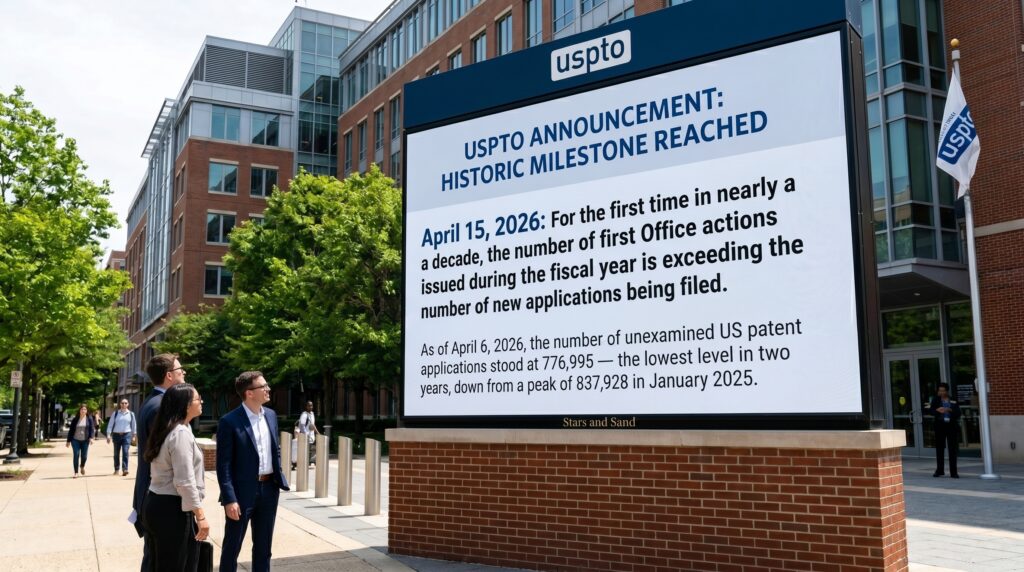
On April 15, 2026, the USPTO made an announcement that practitioners have waited nearly a decade to hear: for the first time in years, the number of first Office actions issued during the fiscal year is exceeding the number of new applications being filed.
As of April 6, 2026, the number of unexamined US patent applications stood at 776,995 — the lowest level in two years, down from a peak of 837,928 in January 2025.
What Drove the Change
The driver is not a slowdown in innovation. It is a deliberate operational overhaul inside the Office. Director John Squires has deployed AI-assisted prior art search tools across examination, launched the ASAP! program to accelerate examination of selected applications through automated pre-search, and expanded examiner capacity across key technology centers. The Office testified before Congress in March that AI is being used in both patent and trademark prosecution to reduce backlog and improve examination quality.
Why Filing Timing Actually Matters
The backlog was a structural deterrent for companies outside the US weighing the cost-benefit of patent prosecution. An application that might sit unexamined for three to four years offered uncertain return on the legal fees required. That calculus has shifted.
First-mover advantage in the patent system is not only about filing date priority. It is also about being examined and granted before a competitor enters the same technology space. The difference between “patent pending” and “US Patent No.” is the difference between a claim and a credential. A granted patent changes your negotiating position in fundraising, licensing, and M&A in ways that a pending application simply cannot.
The Window Is Briefly Aligned
The clearing backlog does not exist in isolation. The July 20, 2026 deadline for foreign applicants to have registered US counsel in place creates a narrow but clear window: companies that move in the next 90 days enter the examination queue at its most favorable position in years, with compliant representation already secured. Companies that wait face both a compliance scramble and a queue that may no longer offer the same advantage.
What to Do
If you have innovations that have not yet been filed in the United States, begin the process now. File with registered US counsel before July 20. You enter the examination queue at its most favorable point in a decade. Both conditions — the clearing backlog and the representation deadline — expire independently of each other. Neither waits.
Trademark Processing Just Dropped from Five Months to Five Minutes
On March 19, 2026, the USPTO launched Class ACT — the Trademark Classification Agentic Codification Tool.
Class ACT automatically assigns international classes, design search codes, and pseudo marks to incoming trademark applications that previously required months of manual preparation by USPTO staff. According to Director Squires, the tool reduces classification and design search coding from five months to five minutes — and in some cases, five seconds.
Why the Bottleneck Was So Costly
Trademark applications that include logos, non-standard typefaces, or design elements have historically been the slowest to process. Not because they were more complex to evaluate — but because they could not be made searchable until manual classification codes were assigned.
Think of a library where every new book had to be hand-catalogued before anyone could search for it. The books were arriving. The cataloguers were backed up. Nobody could find anything in the meantime. The delay compounded at every stage: it pushed back the examining attorney’s review, delayed clearance searches for third parties, and created fundamental uncertainty for applicants trying to plan brand launches around registration timelines.
Class ACT automates the catalogue. Human examiners still review the AI-generated classifications before they become final — but the information is available almost immediately, not months later.
What Else Is New in the Trademark Center
Beginning April 23, 2026, the Trademark Center will include an AI-powered mark description and color claim generator. A new image-search feature allows practitioners to upload a logo and identify visually similar registered marks — functioning like a reverse image search applied directly to the trademark registry.
The First-Use or First-File Problem
US trademark rights operate on a first-use or first-file basis. Every day a brand operates in or adjacent to US markets without US registration is a day someone else can file that name and own it there first. Brand protection in the United States has historically been a low priority for companies focused on product-market fit in local and regional markets. That is a reasonable sequencing decision early on. It becomes an expensive one the moment a brand starts carrying real commercial weight beyond its home market.
The Madrid Protocol allows a single international trademark application to extend protection to over 130 countries simultaneously, including the United States. Combined with Class ACT accelerating the US examination process, the trademark filing workflow is now faster and more predictable than at any point in the past decade. The obstacle was never the idea of protecting the brand. It was the friction of the process. That friction has been materially reduced.
What to Do
Conduct a trademark clearance search for your brand name and logo in the US registry before any US market activity — customer acquisition, investor roadshows, or commercial partnerships. With Class ACT in place, the search is faster and more accurate. If the path is clear, file. Do not wait for the US launch to begin the process. By then, someone may have already arrived.
87% of IP-Owning Companies Have Never Used Their Most Valuable Asset
A report published on April 13, 2026 identified what may be the single largest piece of unleveraged financial infrastructure sitting inside technology companies right now.
Just 13% of IP-owning firms have ever sought financing through their intellectual property assets.
That is not a rounding error. It means the overwhelming majority of companies holding granted patents have been treating those patents as certificates — documents filed and forgotten — rather than the balance sheet items they actually are.
How IP Creates Direct Financial Value
Patents are intangible assets with measurable commercial value. They can be pledged as collateral for debt financing in the same way that physical assets or accounts receivable are pledged to lenders. Between 2016 and 2019 alone, over 400,000 patents were used as security interests in the United States. The practice is well-established in semiconductor, pharmaceutical, and SaaS sectors — particularly among companies with strong IP portfolios but limited tangible assets.

Three mechanisms create direct financial value from a patent portfolio:
Valuation uplift. Granted US patents increase acquisition and fundraising multiples by demonstrating a defensible competitive moat. Series A and B investors pay higher multiples for companies with protected IP than for companies relying on execution speed alone.
Debt collateral. Patents can be pledged as security interests to access debt financing at favorable terms without diluting equity. For technology companies with strong IP but capital-intensive operations, this can be the difference between extending runway on favorable terms and accepting an equity round at a discount to intrinsic value.
Licensing revenue. Granted patents generate recurring royalty income when licensed to third parties in the same technology vertical. That revenue stream is independent of product sales — particularly valuable during periods of capital constraint.
Why Most Founders Don’t Know This
The structural barrier cited most often in the report is not complexity. It is a lack of awareness combined with the absence of advisors who understand both the IP side and the financing side of the transaction. A patent portfolio is not a certificate collection. It is a balance sheet item. Most founders do not know they can borrow against it — which means they are paying for equity dilution they did not need to accept.
Most founders walk into investor meetings knowing their revenue and growth metrics. They cannot quantify their IP assets. That gap costs them in valuation, in terms, and in leverage. It is entirely closable.
What to Do
Commission an IP audit before your next funding round. Know what you own, what it is worth, and how it can be structured for both equity and debt financing conversations. The conversation with your next investor or lender will be materially different if you can answer those questions. Most of your competitors cannot.
Three Questions Before This Quarter Closes
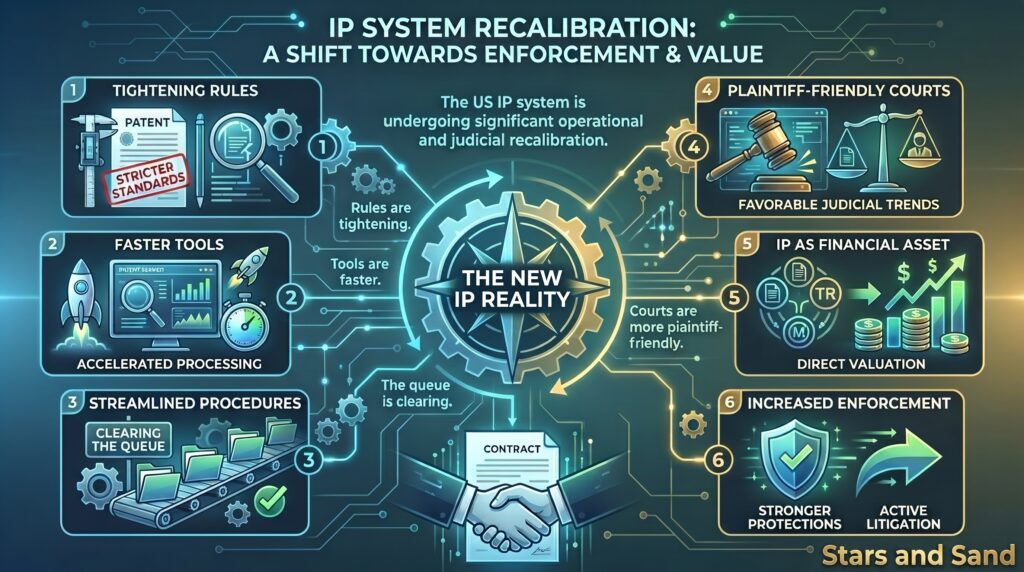
Across six developments now — three from the last issue, three from this one — a single coherent picture emerges. The US intellectual property system is undergoing the most significant operational and judicial recalibration in years. The rules are tightening. The tools are faster. The courts are more plaintiff-friendly. The queue is clearing. And the evidence that IP is a direct financial asset — not just a legal formality — is becoming harder to ignore.
Before the end of this quarter, three questions are worth answering honestly:
Do you have innovations filed — or in process — with registered US counsel before July 20, 2026?
Has your brand been cleared and filed in the US trademark registry?
Do you know what your IP portfolio is worth as a financing asset?
If the answer to any of these is no — or not sure — the next step is a conversation, not a commitment.
— Stars and Sand | US Patents. From the Inside.