The most underused instrument in the US patent system costs less to file than a utility patent, grants faster, and is significantly harder to design around. Most Founders Never File One. The Apple v. Samsung litigation proved it could be worth more than the underlying technology.
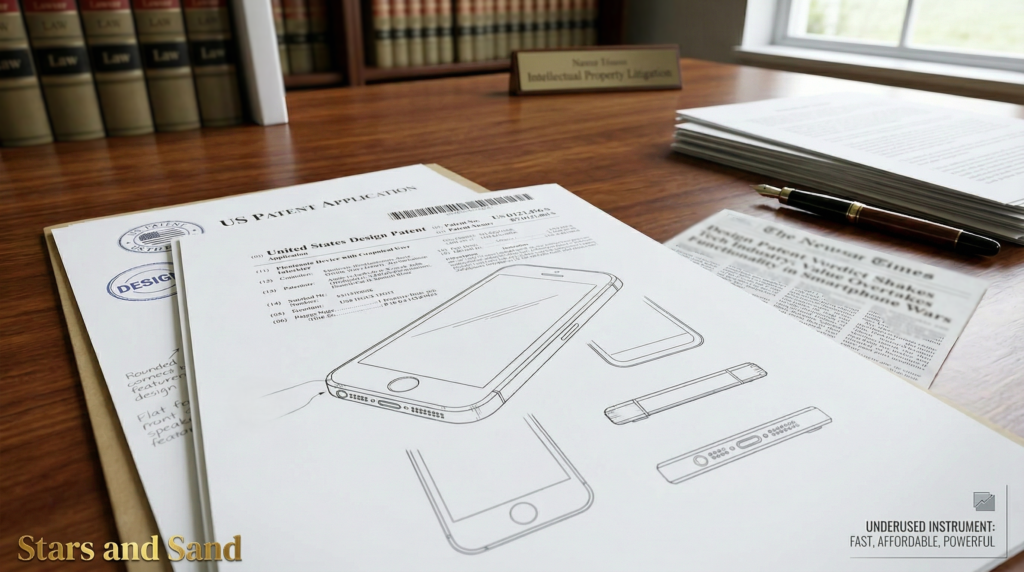
In 2012, a federal jury awarded Apple $1.05 billion in damages against Samsung. The verdict was not primarily grounded in utility patents — the claims covered how the iPhone’s software worked. It was grounded in design patents: US D618,677, covering the black rectangular front face with rounded corners; US D593,087, covering the colorful icon grid on a home screen; and US D504,889, covering the bezel surrounding the display. Samsung had built faster processors, higher-resolution screens, and thinner hardware. None of it mattered. Apple had protected the visual implementation, and that protection proved more durable in court than any technical claim.
Design patents are the category that technically fluent founders systematically ignore. The reasons are understandable and wrong.
What a Design Patent Actually Protects
Utility patents protect function — the specific method or system by which a technical problem is solved. These are the filings that dominate IP strategy conversations and consume the majority of prosecution budgets. A utility patent covering a novel compression algorithm, a data routing method, or a hardware architecture is the canonical IP asset.
Design patents protect ornamental appearance — the visual and aesthetic expression of a product, interface, or component. Under 35 U.S.C. § 171, a design patent covers “any new, original and ornamental design for an article of manufacture.” A single drawing sheet. A fifteen-month average prosecution timeline. Filing costs that run a fraction of utility prosecution. And a twenty-year term from filing date.
The engineering instinct is to dismiss design protection as shallow — a tool for consumer product companies worried about counterfeit packaging, not for technical founders building backend infrastructure or software platforms. That instinct is incorrect for two reasons.
First, the scope of what constitutes a protectable design has expanded substantially since Egyptian Goddess, Inc. v. Swisa, Inc. (Fed. Cir. 2008), which shifted the infringement standard to the “ordinary observer” test. Under this test, infringement is established when an ordinary observer, familiar with the prior art, would consider the accused design substantially similar to the patented design. This is a lower evidentiary bar than claim-by-claim utility patent analysis, and it makes design patents more enforceable, not less.
Second, for any product with a user-facing interface — mobile applications, SaaS dashboards, hardware devices, wearables — the visual implementation is the product from the user’s perspective. A competitor who cannot copy your interface cannot replicate your user experience. Apple understood this. The iPhone’s utility patents covered the technology. The design patents covered everything the user actually touched and saw.
The First-to-File Trap That Founders Do Not See Coming
The America Invents Act of 2013 moved the US fully onto a first-to-file system. Priority belongs to whoever files first, not whoever invented first. This rule applies equally to utility and design patents.
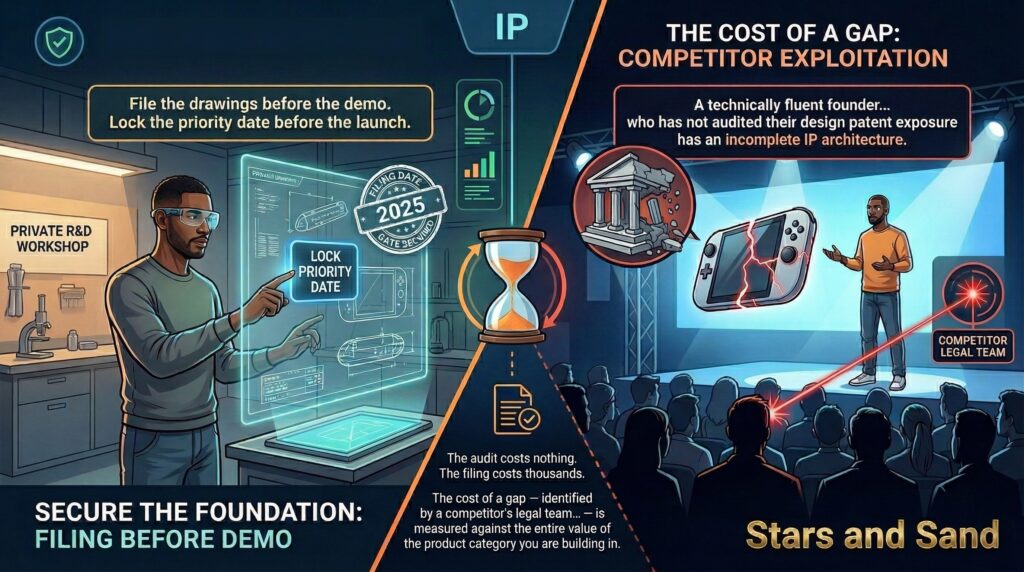
The operational consequence for founders in Lagos, São Paulo, Nairobi, or anywhere outside the US patent system is this: the moment your product is publicly visible — in an app store, at a conference, in a demo video — your filing window is open, and your clock is running. Under 35 U.S.C. § 102, you have a twelve-month grace period from public disclosure to file in the US. That window is not a safety net. It is the maximum amount of time you can afford to wait.
A competitor with resources and legal counsel who sees your interface, your packaging, or your product form at a trade show can file a design patent application before you do. If your design is not already on file, their filing date becomes prior art against your own application. The fact that you shipped the product first is irrelevant to the examiner’s analysis under first-to-file rules.
The corrective action is not complicated. A provisional application — which can be filed for under $2,000 in USPTO fees for a small entity — establishes a priority date. It does not require claims. It requires a description and drawings sufficient to define the design and buys twelve months to prosecute the full application while the priority date is locked.
Design Patents as Licensing Infrastructure
Qualcomm built one of the most profitable licensing businesses in the history of the technology industry not by manufacturing devices, but by owning the foundational patents on CDMA technology and collecting royalties from every manufacturer who needed access. The mechanism was utility patents — SEPs (standard-essential patents) that became mandatory infrastructure for the entire cellular industry.
The design patent equivalent of this model is less discussed but structurally identical at smaller scale. A well-constructed design patent portfolio covering a product category — the specific icon style of a fintech application, the distinctive physical form of a hardware device, the layout architecture of a SaaS dashboard — creates a licensing instrument that competitors must either pay to access or spend engineering resources designing around.
Pfizer’s experience with Viagra is the utility patent version of this dynamic. The moment the compound patent expired in 2012, generic manufacturers flooded the market and Pfizer’s revenue from that product collapsed by over ninety percent. The patent had been generating tens of billions of dollars in exclusivity. Without it, the underlying molecule was worth commodity pricing.
Design patents expire in the same way. Cost of construction is the difference. A utility patent portfolio covering a single technology domain can cost $150,000 to $300,000 to prosecute across major jurisdictions. A design patent portfolio covering the visual implementation of an entire product line can be constructed for a fraction of that, with faster grant timelines and lower maintenance costs.
What the Apple-Samsung Litigation Actually Teaches
Appeal and subsequent proceedings reduced the billion-dollar damages award in Apple Inc. v. Samsung Electronics Co. The final payment Samsung made was substantially lower than the jury’s initial verdict. This is the detail that gets cited to argue the case was less significant than it appeared.
That reading misses the architecture of what Apple built. The design patent litigation was not primarily a damages strategy. It was a market access strategy. By maintaining active litigation across multiple jurisdictions simultaneously — the US, Germany, Australia, the UK, the Netherlands, South Korea — Apple forced Samsung into a defensive posture that consumed engineering resources, legal budgets, and product development cycles. The rounded corners were not the point. The sustained pressure of defending against a well-constructed design patent portfolio across every relevant market was the point.
For a founder building a product in a category where larger incumbents operate, this is the relevant lesson. A design patent portfolio is not primarily a tool for collecting damages. It is a structural barrier that forces incumbents to negotiate rather than copy. When your interface, your product form, or your packaging is protected by filed rights across key jurisdictions, the incumbent’s calculus shifts from “replicate and scale” to “license, acquire, or route around.” All three outcomes are preferable to competing against a company with unlimited resources and no legal constraint on imitation.
The Strategic Deployment Decision
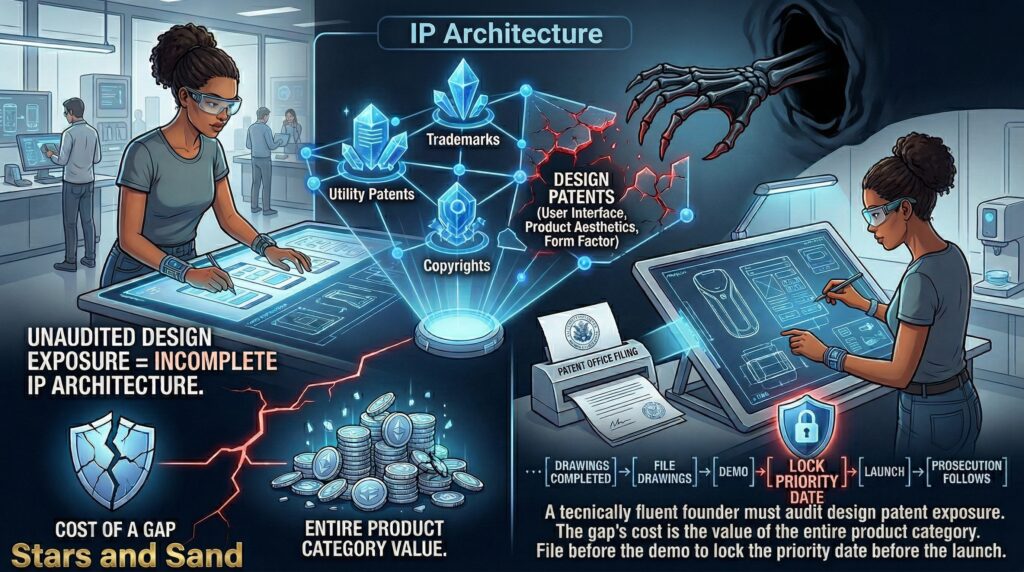
A technically fluent founder building a user-facing product in 2025 who has not audited their design patent exposure has an incomplete IP architecture. The audit costs nothing. The filing costs thousands. The cost of a gap — identified by a competitor’s legal team before it is identified by yours — is measured against the entire value of the product category you are building in.
File the drawings before the demo. Lock the priority date before the launch. The prosecution can follow. Nothing can recover the date.
Stars and Sand is not a law firm and does not provide legal advice. This article is for informational purposes only. Consult qualified patent counsel before making any IP decisions.
— Stars and Sand US Patent Strategies for the World