The System Just Got Harder to Navigate IP.
For some, the US patent system just got harder to navigate. The cost of getting US IP wrong just skyrocketed. Here is what changed this quarter — and what it now costs to miss it.
There is a version of the US patent system that founders outside the United States have been navigating for years. File a PCT application. Respond to office actions with in-house counsel or a foreign attorney. Use AI tools to accelerate the inventive process. Move fast.
That version of the system no longer exists.

Three decisions landed in Q1 2026. Each one closes something. Together, they represent the most significant tightening of the US IP system in years — and the cost of not knowing about them is not a fine or a delay. It is the quiet, permanent loss of rights you thought you already owned.
The Supreme Court Closes the AI Authorship Question
On March 2, 2026, the United States Supreme Court declined to hear Thaler v. Perlmutter (No. 25-449). Dr. Stephen Thaler had spent years arguing that an AI system should be recognized as the sole author of a copyrighted work. The Court’s refusal to hear the appeal left the DC Circuit’s ruling intact: no human authorship, no copyright protection.
This is not an isolated ruling. It is the final piece of a trilogy.
In 2022, the Federal Circuit held in Thaler v. Vidal that AI cannot be named as an inventor on a US patent. In November 2025, the USPTO rescinded guidance that had allowed broader AI contribution to inventorship — replacing it with a strict return to traditional human conception standards. The Supreme Court’s March decision closes the copyright side of the same question.
The Office’s position is now unambiguous on both tracks. A human being must have conceived the invention. Not assisted with it. Not prompted the AI that produced it. Conceived it.
Why the Standard Is Harder Than It Sounds
Most competitive engineering teams have stopped distinguishing between “the AI generated this” and “I directed the AI to generate this.” The USPTO now treats that distinction as the entire question.
The Federal Circuit made the standard concrete in its April 2025 Recentive Analytics decision. A patent that merely implements an abstract idea of data analysis using generic machine learning models on conventional computing infrastructure is not patent-eligible. The bar is not whether a human touched the work. The bar is whether a human made a specific, identifiable conceptual contribution to each claim element.
Think of it like architectural credit. If a contractor builds a house using software that auto-generates the structural plans, and you later try to patent the design, the first question is: who solved the structural problem? Who made the conceptual decision? If the answer is the software, you do not have a patent. You have a filing fee receipt.
Your engineering notebooks, commit histories, architecture decision records, and design documents are no longer just development artifacts. They are the evidentiary foundation of your patent’s validity.
What to Do
Begin maintaining human inventorship logs now. For every novel feature shipped with AI assistance, document who conceived the core idea, what specific technical problem they were solving, and what the AI contributed versus what the human engineer directed. Without that record, you cannot defend inventorship if challenged. Under the new USPTO framework, that challenge will come.
The Representation Rule Closes the Self-Navigation Loophole
On March 20, 2026, the USPTO published a final rule in the Federal Register. Effective July 20, 2026, every company or individual whose domicile is outside the United States must be represented by a registered US patent practitioner for all substantive patent filings.
It can not be foreign IP counsel. Nor in-house lawyers without USPTO registration. Not even the founder navigating the system alone. A registered US patent attorney or patent agent who has passed the USPTO bar.
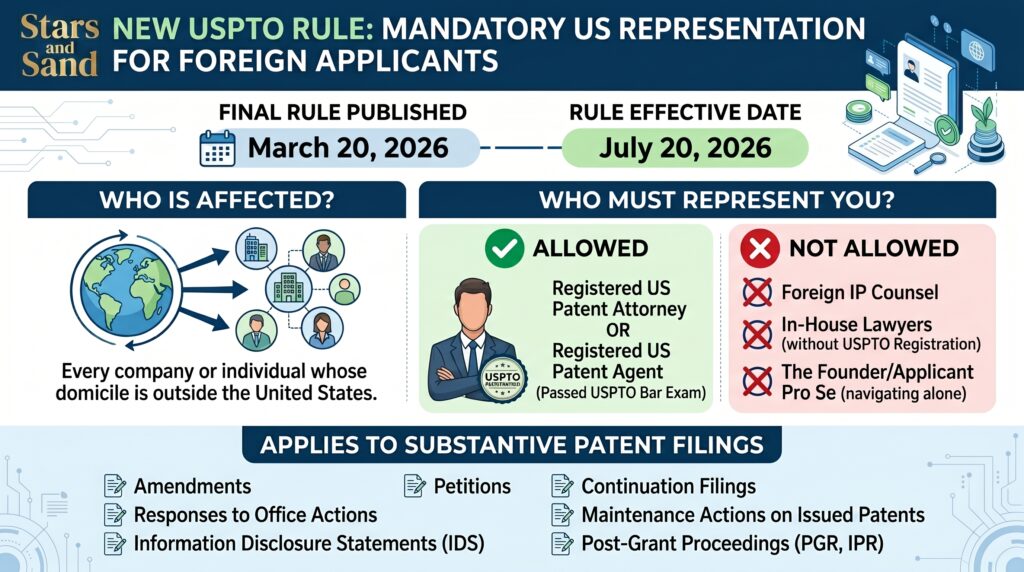
The rule covers everything beyond the initial application: amendments, responses to office actions, information disclosure statements, petitions, continuation filings, maintenance actions on issued patents, and post-grant proceedings.
The Detail That Should Get Your Attention
A foreign applicant who files without a registered practitioner’s signature will receive a filing date. That part works. But inventorship will not be set. Priority claims will not take effect. Any submission requiring a practitioner signature will simply not be entered.
A filing date without proper representation is like a ticket with no seat number. You are technically on the manifest. But when the plane lands, your rights do not exist. And the clock keeps running the entire time.
The USPTO’s own data shows that over 55% of patent applications filed in fiscal year 2022 had at least one foreign inventor. This rule does not close the door to foreign filers. It closes the workaround that allowed founders and in-house teams to navigate the system informally — and in doing so, lose rights they did not know they were forfeiting.
The Scope Is Broader Than New Filings
The rule applies not only to new applications. It applies to all substantive filings in pending applications and issued patents received on or after July 20, 2026. If you have an application currently in prosecution, you need a registered US practitioner in place before that date. If you have issued patents with maintenance actions due after July 20, the same applies.
What to Do
July 20 is a hard deadline. Identify and engage a registered US patent practitioner before that date — for pending filings, issued patents with upcoming maintenance, and any new applications you plan to file. The cost of getting this wrong is not a rejection letter. It is the silent disappearance of rights you believed you already held.
The Litigation Climate Closes the Gap Between Holding a Patent and Enforcing IP
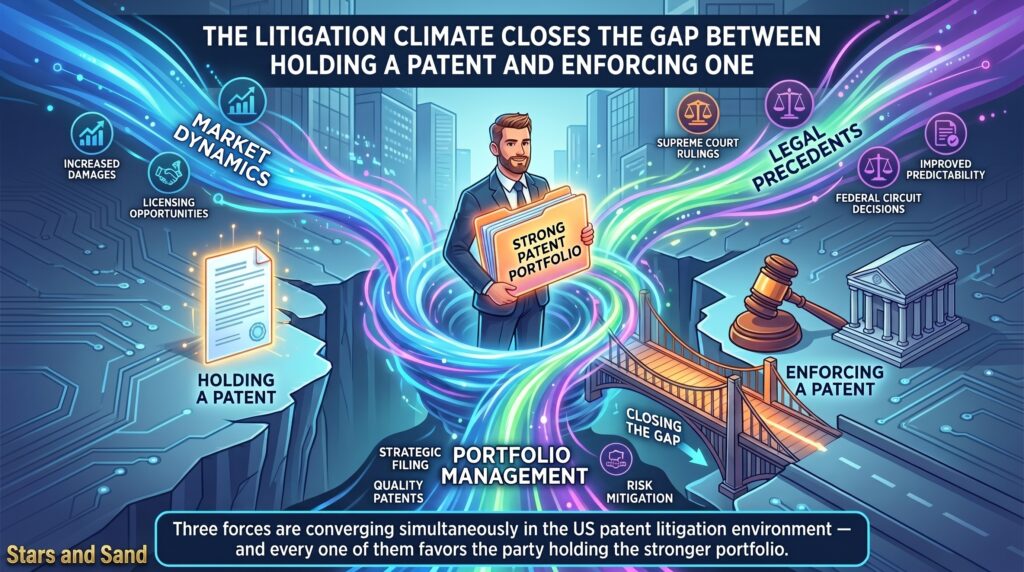
Three forces are converging simultaneously in the US patent litigation environment — and every one of them favors the party holding the stronger portfolio.
The PTAB Has Changed Posture
The Patent Trial and Appeal Board under Director John Squires has adopted a markedly more pro-patent stance. Inter partes review petitions — the mechanism competitors use to challenge and invalidate your patents after grant — are now harder to institute. Patent owners have more procedural leverage. The PTAB that critics once called a patent death squad is, per multiple practitioners, now urging petitioners to focus only on clear error-correction cases.
The practical effect: a granted US patent is worth more today than it was two years ago. The mechanism for invalidating it is harder to trigger.
Courts Are Granting Injunctions Again
From the ITC to district courts, judges are increasingly willing to grant injunctive relief — including for standard-essential patents, a category long considered inhospitable to such remedies. Germany, Brazil, and Colombia have all issued preliminary injunctions in SEP cases in recent months. The enforcement trend is global.
The Federal Circuit Sends a Warning to Everyone Operating Across Borders
In March 2026, the Federal Circuit vacated a $185 million jury verdict against Gen Digital (Norton) in a case brought by Columbia University. The infringement finding was valid. The damages calculation was not — because it improperly included foreign sales of software manufactured and installed outside the United States.
The message from the court is precise: know where your code runs, where your servers sit, and where your distribution chain begins. That geography determines whether your damages are $185 million or effectively zero.
The Double Edge
A stronger enforcement environment cuts both ways. For companies with protected IP entering US markets, your granted patents carry more weight at the negotiating table and in court than at any point in the last decade. For companies without protected IP — competing in US markets or selling into US enterprise accounts — incumbents holding patent portfolios are now more likely to reach for litigation as a competitive weapon.
The data center patent wave illustrates this clearly. Cooling systems, server rack architectures, and power management protocols across AI compute infrastructure are actively being litigated. Any company building or operating AI infrastructure needs to understand what patent exposure exists across its technology stack before a competitor explains it in a complaint.
What to Do
Conduct a freedom-to-operate analysis before your next product launch or US market entry. In a pro-patent environment, your competitors’ portfolios are a risk register, not background noise. And if you hold patents, the environment is now favorable enough that enforcement — through licensing or litigation — deserves a place in your strategy.
Read These Three Together
The Supreme Court’s AI ruling means your human engineers are the only legal origin point for your IP. The USPTO’s representation rule means that navigating the US patent system without a registered practitioner is no longer a cost-saving shortcut — it is a rights-destroying procedural trap. And the pro-patent litigation environment means that the patents you file today carry more enforcement leverage than at any point in the last decade.
The rules, as of this quarter, are unambiguous. File correctly, document human contribution, engage registered US counsel before July 20 — or cede the ground to competitors who already have.
Next issue: the news cuts the other way. The queue is clearing, trademark processing just got radically faster, and 87% of IP-owning companies are sitting on financing power they have never touched.
— Stars and Sand | US Patents. From the Inside.