How Public Filings Become Your Competitor’s Roadmap
Matti Makkonen designed the SMS protocol in 1991. He didn’t patent it. Within a decade, SMS generated over $1 trillion in global revenue while Makkonen received nothing. He didn’t lose to a thief; he lost to a flawed architecture. He left his value on the table because he failed to build a protection strategy.
Most founders see this and think the answer is to file everything. That is a fatal mistake.
The US IP system does not exist to protect your innovation; it exists to reward your disclosure. For a well-capitalized incumbent, the system is a fortress. For a lean startup, a naive filing is a publicly indexed map of your best ideas—handed to your adversaries at filing cost and litigated on their terms.
The question isn’t whether to engage. It’s how to ensure you aren’t the one paying to train your competition.
The Architecture of Intimidation: Flooding the Zone
A US patent is a trade: the government grants you a temporary monopoly, and in exchange, you publish a blueprint detailed enough for a “Reference Engineer” to replicate your work.
For giants like Qualcomm, IBM, and Nokia, this is a favorable trade. They don’t file patents to protect products; they file to saturate the vertical. By building a dense thicket of claims across an entire technology stack—from baseband chips to handset protocols—they create a “litigation shadow.”
In this model, volume is the weapon. Any competitor entering the space finds themselves trapped. They cannot build without infringing, and the cost of finding a “clean” path around a thousand-patent portfolio is prohibitive. The goal isn’t just to own an idea, but to make the entire market structurally dependent on your portfolio.
If you aren’t prepared to spend millions on litigation and maintenance, filing a utility patent is often just paying to provide your competitor with a “design-around” guide.
The Air-Gap Strategy: Defensive Invisibility
For the pre-Series A team or the solo founder, the most powerful IP asset is the one that costs $0 in filing fees and never expires: The Trade Secret.
Think of it as an air-gapped system. A machine disconnected from the network has no attack surface. Similarly, what your competitor cannot see, they cannot reverse-engineer, litigate against, or steal from a USPTO database.
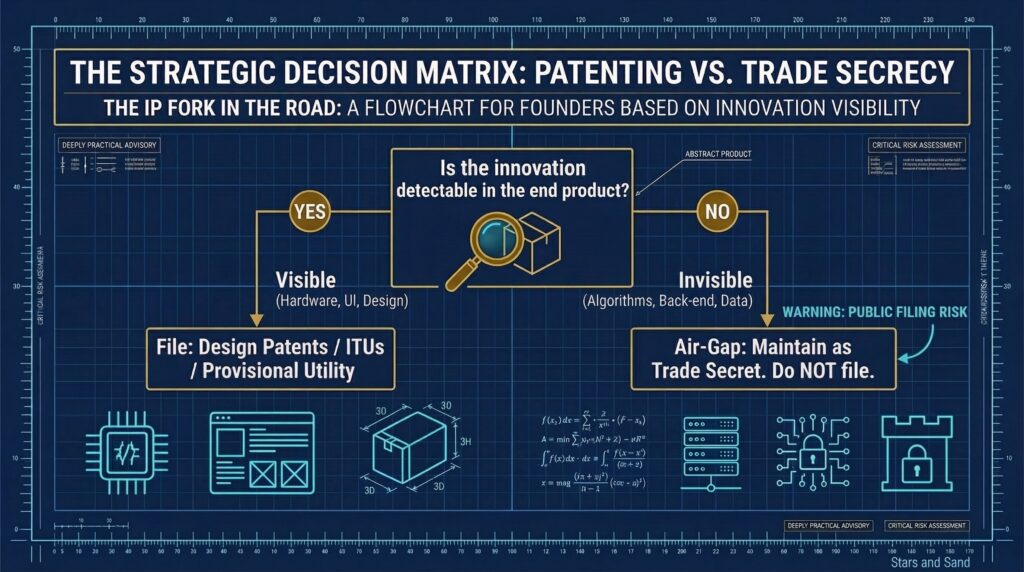
The Air-Gap works for:
- Back-end algorithms and proprietary scoring.
- Model architectures and training data pipelines.
- Any process where the value lives in the mechanism rather than the output.
Coca-Cola has protected its formula for 130 years by refusing to patent it. A patent would have expired over a century ago; the trade secret remains a trillion-dollar asset.
The Catch: Protection requires relentless operational hygiene. The moment your “secret” enters the public domain through a leak or a loose-lipped demo, the asset is permanently extinguished. There is no refiling. You must enforce NDAs, audited access logs, and strict exit protocols as if your company’s life depends on them—because it does.
Controlled Exposure: When You Must Signal
Some innovations are too visible to hide—the UI, the hardware form factor, or the brand identity. When you cannot stay invisible, you must control the terms of your disclosure.
- Design Patents: These protect the “look” without revealing the “how.” They keep your internal mechanics air-gapped while staking a claim on your visual identity.
- Intent-to-Use (ITU) Trademarks: This is your stealth instrument. It establishes a national priority date months before you commit to a market launch, providing protection without telegraphing your commercial trajectory.
- Provisional Utility Filings: Think of this as a 12-month disclosure clock. It locks in your priority date while giving you a year to decide if the innovation is worth the “disclosure price” of a full patent.
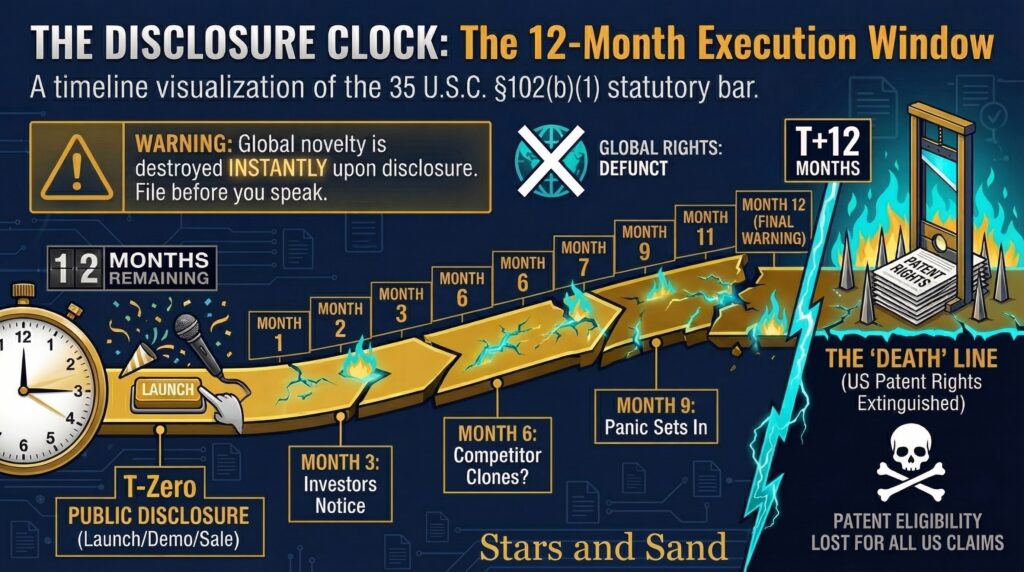
The Strategic Choice
Map every asset against one question: Does the value live in the visible output, or the invisible process?
Visible assets get registered; invisible assets stay in the air-gap. The firms that thrive in this system understand its dual nature. They don’t file because they’re “supposed to”—they file because it’s a calculated move to corner a market or a deliberate choice to stay hidden.
Decide which side of the system you intend to be on before you send your first signal to the world.
— Stars and Sand
US Patent Strategies for the World